
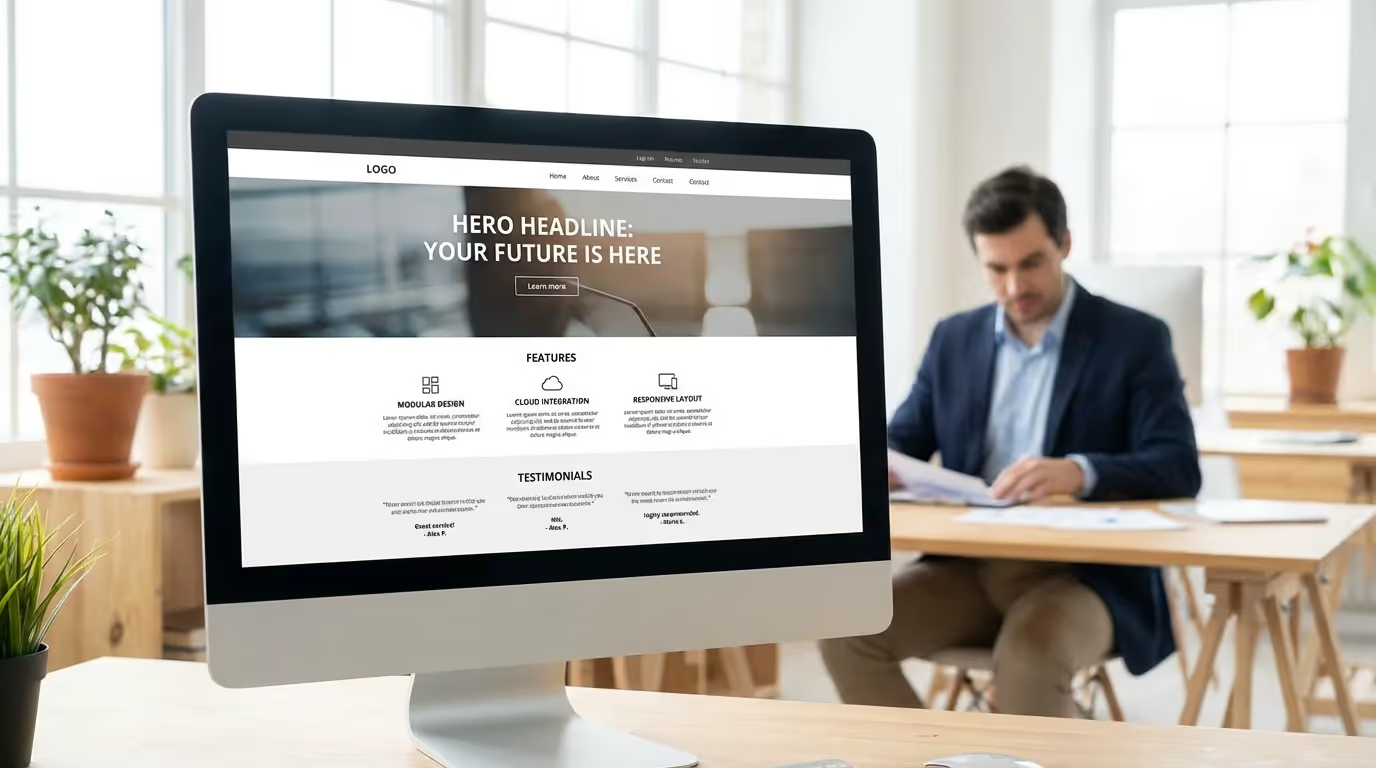
What does it take to build a website that performs well today and still holds its value years from now? That question drives the growing interest in Webflow Evere, a concept rooted in creating evergreen, future-proof websites using Webflow's no-code platform. Webflow generated $213 million in revenue in 2024 and is valued at $4 billion, making it one of the most successful no-code platforms. These numbers reflect a clear industry shift toward visual, maintainable web development.
Building an evergreen site means designing for longevity: clean code, optimized performance, SEO-ready architecture, and effortless content updates. The global low-code and no-code development platform market is projected to grow from $28.11 billion in 2024 to $35.86 billion in 2025. Businesses that invest in durable, scalable web assets today are positioning themselves to capture that momentum rather than chase it.
What Does "Webflow Evere" Actually Mean?
The term Webflow Evere combines Webflow's visual development platform with the concept of "evergreen" web design. An evergreen website is one that remains relevant, functional, and high-performing over time without requiring constant rebuilds. Unlike trend-driven designs that feel dated within months, evergreen sites prioritize clean structure, responsive layouts, and content that adapts as your business grows.
On the Webflow marketplace, templates like Evergreen and Everett illustrate this philosophy. They feature modular, responsive layouts with CMS integration, style guides, and utility pages that simplify long-term maintenance. Launched in 2013, Webflow has grown from a niche tool for designers to a platform used by freelancers, agencies, and large enterprises alike. Its visual editor, CMS features, and e-commerce capabilities make it a versatile solution for building everything from personal portfolios to complex business websites.
For B2B companies, this approach is especially valuable. Your website should serve as a reliable growth asset, not a recurring expense. An evergreen Webflow site achieves this by pairing visual design freedom with structured, SEO-friendly content management.

Why Evergreen Web Design Matters More in 2026
The pressure to launch fast often leads to short-sighted design choices. Yet Gartner forecasts that by 2026, low-code will account for 75% of new application development, with 80% of citizen developers using low-code tools. This signals that websites built with no-code platforms like Webflow are not temporary experiments; they are becoming the standard for enterprise and mid-market organizations alike.
The market for low-code development technologies is projected to grow to $44.5 billion by 2026 at a compound annual growth rate (CAGR) of 19%, with a potential opportunity for adjacent services of between $69 billion to $92 billion. Companies investing in evergreen, no-code web development now stand to benefit from a rapidly expanding ecosystem of tools, integrations, and talent.
An evergreen approach also protects your investment. Redesigning a website every 12 to 18 months is expensive and disruptive. When you build with modular components, a robust CMS, and scalable hosting, updates become incremental rather than wholesale. That is the core promise of the Webflow Evere philosophy.
Key Features That Make Webflow Ideal for Evergreen Sites
Several built-in capabilities distinguish Webflow from other website builders when it comes to building sites that last.
- Visual CSS Grid and Flexbox controls: Webflow gives you precise layout control through a visual interface, producing clean, semantic HTML and CSS. No bloated plugins or shortcodes.
- Integrated CMS: Structured content collections allow marketing teams to add blog posts, case studies, or product pages without touching the design layer.
- AWS-backed hosting: Webflow brings a professional-grade visual designer, a flexible CMS, and secure global hosting together, so teams can iterate quickly without waiting on engineering. In a sentence: pixel-perfect sites with enterprise-grade hosting, minus the engineering queue.
- Responsive design: Every element is editable across breakpoints, ensuring your site adapts gracefully to current and future devices.
- Reusable components: Symbols and component libraries let you update a header, footer, or CTA block once and reflect changes site-wide.
These features combine to create a foundation that requires fewer overhauls and supports continuous improvement. If you want to boost your Webflow site's performance, the platform's clean code output and built-in optimizations make that process straightforward.
Templates vs. Custom Builds: Choosing the Right Evergreen Path
Should you start with a template or invest in a fully custom design? The answer depends on your goals, timeline, and budget.
Webflow offers over 7,000 free and premium HTML website templates, fully customizable for business, portfolio, or personal use, that let you design and launch with Webflow's powerful platform. Templates like Evergreen, Everett, and similar options provide a solid starting point with pre-built responsive layouts, CMS pages, interaction animations, and style guides.
However, templates have limitations. They serve as a foundation, but a B2B company with specific branding requirements, complex user journeys, or advanced integrations will likely outgrow a template quickly. A custom Webflow build, on the other hand, is architected around your unique business logic from day one.
| Criteria | Template-Based Build | Custom Webflow Build (Our Approach) |
|---|---|---|
| Time to launch | 1–2 weeks | 4–8 weeks |
| Design uniqueness | Moderate (shared layouts) | High (tailored to brand) |
| SEO optimization | Basic structure included | Deep, conversion-focused architecture |
| Scalability | Limited by template structure | Built for growth from the start |
| Long-term cost | Lower upfront, higher redesign risk | Higher upfront, lower total cost of ownership |
Our Webflow development services follow the custom path. We design conversion-focused, evergreen sites with SEO-optimized structures and full source code access, so you own your digital asset completely.
How to Build an Evergreen Webflow Site: A Practical Framework

Building a website that stands the test of time requires intentional planning at every stage. Here is a five-step framework for creating a Webflow evergreen site.
- Define your content architecture first. Map out CMS collections, page types, and content relationships before opening the visual designer. An evergreen site starts with structured data.
- Design with a system, not just pages. Create a comprehensive style guide with typography scales, color tokens, spacing units, and reusable components. This ensures visual consistency as the site grows.
- Optimize for performance from day one. Use Webflow's native image compression, lazy loading, and minimal custom code. Based on data from W3Techs from 2023 to 2025, the number of websites that use Webflow have increased at an average of 15.48%. As of 2025, Webflow is used by 0.8% of all websites in the world. Fast-loading sites retain visitors and rank higher.
- Build for SEO at the structural level. Configure clean URL slugs, meta tag templates, Open Graph settings, and XML sitemaps within Webflow's native tools. Each CMS item should have editable SEO fields.
- Plan for content updates without design changes. Use the Webflow Editor to empower marketing teams to publish and edit content without accessing the Designer. This separation of concerns keeps the design layer stable.
Following this framework produces a site that can evolve through content additions and incremental refinements rather than expensive redesigns.
SEO and Performance: The Evergreen Advantage
An evergreen website is only valuable if people can find it. The no-code website builder tools market was valued at $1.97 billion in 2023 and is estimated to reach $3.58 billion by 2031, growing at a CAGR of 7.73%. As competition in this space intensifies, the sites that win are the ones built with technical SEO embedded in their DNA.
Webflow offers several native SEO features that support long-term visibility: auto-generated sitemaps, 301 redirect management, customizable meta tags per page, alt text fields for images, and clean semantic markup. Unlike platforms that rely on heavy plugins for basic SEO functions, Webflow keeps the stack lean.
Performance plays an equally important role. Webflow gets a 43.38% bounce rate, and when we consider that 26-40% is ideal, Webflow can be regarded as approximately average. This highlights that while the platform provides a strong foundation, achieving top-tier results still requires expert implementation. Proper image sizing, strategic use of interactions, and efficient class naming all contribute to faster load times and lower bounce rates.
For businesses that want to go further, combining a well-built Webflow site with dedicated SEO services creates a compounding advantage. The technical foundation amplifies every piece of content you publish.
Scaling Your Evergreen Webflow Site for Growth
Webflow has experienced remarkable growth, solidifying its position as a leading platform in the web design and development industry. As of 2021, Webflow's user base surpassed 3.5 million worldwide. In that year alone, the platform welcomed 1 million new users. That growth reflects a broader shift: businesses of all sizes are choosing Webflow for its scalability.
An evergreen site does not mean a static site. Scaling involves adding new CMS collections (case studies, integrations, partner pages), expanding into multilingual content with Webflow's localization features, and integrating with third-party tools for CRM, analytics, and marketing automation.
E-commerce is another growth vector. Over 15,463 stores currently use Webflow's e-commerce functionality. For B2B companies exploring product catalogs or gated resources, Webflow's native e-commerce and membership features offer a path forward without migrating to a different platform.
The key to sustainable scaling is maintaining the architectural discipline you established at launch. When your content architecture, component library, and style guide are solid, adding new sections or pages becomes an additive process rather than a structural challenge. If you are planning a new digital presence, exploring how to create a website in 2025 with these principles in mind is a strong starting point.
Common Mistakes That Undermine Evergreen Webflow Sites
Even with the right platform, poor decisions during the build phase can erode the evergreen potential of your site. Here are the most frequent pitfalls.
- Over-relying on custom code: Excessive JavaScript or third-party scripts can break during Webflow updates and slow performance. Use native interactions whenever possible.
- Ignoring the style guide: Without defined design tokens, inconsistencies accumulate as different team members make edits. A style guide is your site's immune system.
- Flat content architecture: Hardcoding content directly into pages instead of using CMS collections creates maintenance nightmares. Structured data scales; static text does not.
- Neglecting mobile-first design: Organizations adopting low-code report 50-70% faster development cycles and significant cost reductions compared to traditional development methods. But those gains evaporate if the mobile experience is an afterthought. Build responsive from the start.
- Skipping analytics setup: An evergreen site requires data to guide its evolution. Integrate analytics, heatmaps, and conversion tracking before launch, not months later.
Avoiding these mistakes requires experience and discipline. Working with a specialized team that understands Webflow's capabilities and limitations makes the difference between a site that lasts and one that needs replacing within a year.
Conclusion: Building a Website That Works for Years
The concept behind Webflow Evere is straightforward: build once, build well, and let your website compound value over time. With the low-code market projected to grow to $44.5 billion by 2026, the ecosystem supporting these platforms will only become richer. Businesses that invest in evergreen, well-architected Webflow sites today are making a strategic bet on the future of web development.
Success requires more than selecting the right platform. It demands thoughtful content architecture, modular design systems, performance optimization, and a commitment to structured, SEO-driven content. Every decision during the build phase either extends or shortens your site's useful life.
We bring together UX/UI design, Webflow expertise, and growth marketing under one roof, with guarantees including full source code access, IP transfer, and a 100% refund on unsatisfactory initial designs. To explore how an evergreen approach can transform your digital presence, discover our professional web design offering and start building a site that works for years, not months.
Frequently Asked Questions
Is Webflow a good platform for building long-lasting B2B websites?
Yes. Webflow's visual editor, integrated CMS, and AWS-backed hosting provide a strong foundation for B2B sites that need to scale. Its no-code approach allows marketing teams to update content independently, reducing reliance on developers. We specialize in building Webflow sites with this evergreen philosophy, ensuring your site stays relevant and high-performing.
How does an evergreen Webflow site differ from a standard template site?
An evergreen site is built around a defined content architecture, reusable component library, and comprehensive style guide. A standard template may look polished initially but lacks the structural discipline needed for long-term growth. Evergreen sites require fewer rebuilds and support continuous content expansion.
What is the typical cost of a custom evergreen Webflow build?
Costs vary based on scope, but a custom Webflow build typically ranges from $5,000 to $30,000 depending on the number of pages, CMS complexity, and integration requirements. While higher than a template, the total cost of ownership is often lower because the site requires fewer redesigns over its lifespan.


