
By 2026, Gartner projects the low-code development market will reach $44.5 billion, growing at 19% annually. That staggering trajectory signals a fundamental shift in how businesses build their digital presence. At the center of this shift sits Webflow, a platform that blends visual design control with production-ready code output.
Whether you are a marketing team tired of waiting on developers, a startup seeking speed to market, or an agency scaling client work, Webflow offers a compelling path forward. This guide breaks down what Webflow is, why it matters, how its features serve different business needs, and where it fits in the broader landscape of no-code website builders.
What Is Webflow and Why Does It Matter?
Webflow is a Software as a Service (SaaS) platform that combines a visual website editor, a content management system (CMS), and integrated hosting into a single product. Based in San Francisco, Webflow provides software as a service for website building and hosting. Unlike traditional drag-and-drop builders, Webflow is a SaaS application that allows designers to build responsive websites with browser-based visual editing software, and it automatically generates HTML, CSS, and JavaScript.
Founded in 2013, the company has grown from a Y Combinator graduate into a platform valued at $4 billion. Webflow has a valuation of $4 billion as of its Series C funding round and has raised a total of $334.9 million in funding to date. Its positioning as a "Website Experience Platform" (WXP) reflects a strategic evolution beyond simple site building into analytics, personalization, and optimization.

Webflow by the Numbers: Market Share and Growth
How fast is Webflow actually growing? The data tells a clear story. In 2025, Webflow holds a 1.2% market share among websites using a content management system, translating to 0.8% of all websites, or approximately 493,226 active websites. While that may seem small against giants like WordPress, context matters.
Webflow's CMS market share has grown steadily, rising from 0.9% in 2022 to 1.2% in 2025, a compound annual growth rate of about 10%. On the revenue side, the numbers are even more striking. Webflow generated $213 million in revenue in 2024, representing 66% growth from 2023.
For e-commerce specifically, Webflow has seen remarkable growth; from 2020 to 2023, the number of active Webflow e-commerce websites increased by 647.81%. These numbers position Webflow not as a niche experiment, but as a rapidly maturing platform with serious enterprise traction.
Core Features That Set Webflow Apart
What makes Webflow different from the dozens of other website builders on the market? Three pillars define the platform.
Visual Designer with Clean Code Output
Webflow's visual editor gives you pixel-level control over layouts using CSS Grid and Flexbox. Every design decision you make in the visual canvas translates into clean, semantic HTML, CSS, and JavaScript. There is no bloated code, no hidden shortcodes. Unlike traditional drag-and-drop platforms, Webflow generates clean HTML, CSS, and JavaScript code while maintaining an intuitive visual interface.
Built-in CMS and Hosting
Websites built on Webflow are powered by Amazon CloudFront and hosted on Fastly. Webflow is an all-in-one platform with a CMS built in, and it does not require external plugins. This architecture delivers fast load times and 99.99% uptime, which eliminates the plugin compatibility headaches common on other platforms.
Interactions, Animations, and GSAP
In October 2024, Webflow acquired GreenSock, the company behind the JavaScript animation library GSAP. This acquisition gave Webflow native access to one of the web's most powerful animation engines, enabling rich, performant interactions without custom code. For brands that want to stand out visually, this is a significant differentiator.
Webflow's AI Evolution: From Builder to Experience Platform
The biggest story in web development right now is how AI reshapes every step of the process. Webflow has embraced this shift aggressively.
In October 2024, Webflow introduced an AI Assistant that can generate sections, copy, and provide in-context guidance while building. In December 2024, it expanded AI capabilities to allow one-click text generation and modification within the CMS. By February 2025, Webflow launched an AI Site Builder in beta that can scaffold entire sites in minutes based on user prompts.
The Model Context Protocol (MCP) server, introduced by Webflow in 2025, allows AI agents and automation tools to securely connect to Webflow projects and interact with both site data and design in real-time. This positions Webflow as more than a builder; it becomes an AI-native website experience platform where marketing teams can test, personalize, and optimize without engineering bottlenecks.
This matters for businesses seeking speed. Gartner forecasts that by 2026, low-code will account for 75% of new application development, with 80% of citizen developers using low-code tools. Webflow's AI features align perfectly with this trend, empowering non-technical teams to ship faster.
SEO and Performance: Does Webflow Deliver?
A beautiful website is worthless if search engines cannot find it. How does Webflow perform on SEO and page speed?
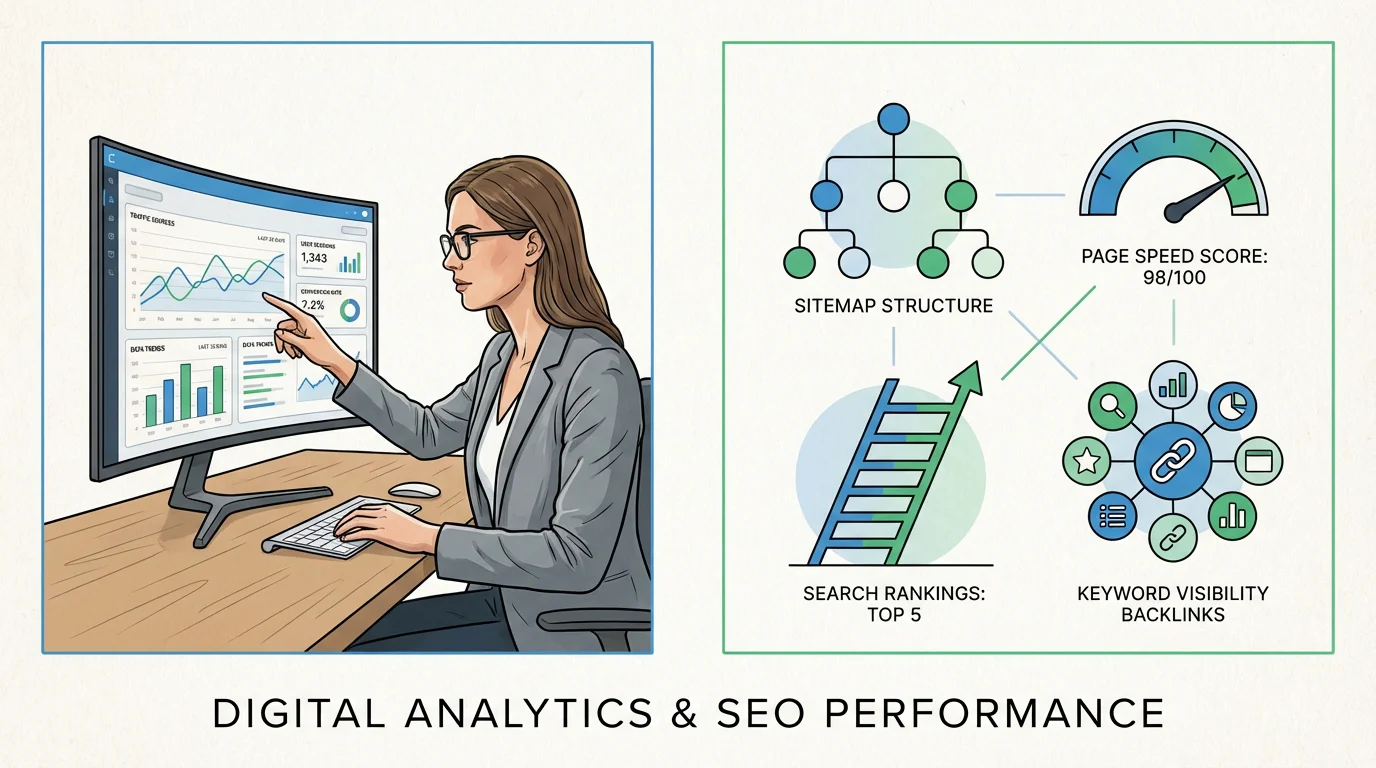
Webflow generates semantic, clean code by default. It auto-generates XML sitemaps, supports custom meta tags, offers 301 redirects, and provides schema markup. Its hosting on a global CDN (backed by AWS and Fastly) typically delivers strong Core Web Vitals scores out of the box.
For teams that want to go further, Webflow recently introduced AI-driven SEO and AEO auditing tools that analyze technical and on-page factors. Answer Engine Optimization (AEO) is a new frontier; making your site readable by AI-driven search tools like ChatGPT and Google AI Overviews. Webflow has built this directly into its platform.
Of course, technical foundations alone do not guarantee rankings. Strategy, content depth, and backlink authority still matter. That is where working with a specialized team can accelerate results. Our SEO optimization services complement Webflow's built-in capabilities with data-driven strategy. You can also boost your Webflow site performance with targeted optimization techniques.
Who Should Use Webflow (and Who Shouldn't)
Webflow is not the right tool for everyone. Understanding its ideal use cases prevents costly mismatches.
Webflow works well for:
- B2B companies and SaaS brands needing conversion-focused marketing sites
- Agencies managing multiple client projects with visual CMS handoffs
- Designers who want code-level control without writing code
- Enterprise marketing teams that need to publish and iterate independently
Webflow may not be ideal for:
- Large-scale e-commerce stores requiring advanced inventory and multi-channel selling (dedicated platforms handle this better)
- Simple personal blogs where cost is the primary concern
- Projects requiring extensive backend logic or user authentication systems
Webflow has several notable limitations including a 100 static page limit per project and 10,000 CMS items per site. The platform also requires a stable internet connection since it is entirely cloud-based. For B2B marketing sites and brand-driven experiences, however, these limits rarely pose a problem.
If you are looking to create a website in 2025 that balances design sophistication with marketing agility, Webflow consistently ranks among the strongest choices.
Webflow Compared: Where It Fits in the Market
Choosing a website platform requires comparing real capabilities. The table below places Webflow alongside major alternatives using verified data.
| Platform | CMS Market Share (2025) | Visual Design Control | Built-in Hosting | Clean Code Output | AI Features |
|---|---|---|---|---|---|
| Webflow (via our development services) | 1.2% | Pixel-level (CSS Grid/Flexbox) | Yes (AWS/Fastly CDN) | Yes (HTML/CSS/JS) | AI builder, CMS generation, SEO/AEO audit |
| WordPress | 61.3% | Theme-dependent | Requires third-party | Plugin-dependent | Via plugins |
| Wix | 3.3% | Unstructured drag-and-drop | Yes | No (proprietary) | AI site generator |
| Squarespace | 2.2% | Grid-based templates | Yes | No (proprietary) | Limited |
Among sites that use a CMS, 1.2% are built with Webflow. Its share among the top 1 million sites is even higher, about 1.5 to 1.8%, and up to 3.4% in the top 1,000 sites. This concentration among high-traffic, high-profile websites signals that enterprise teams increasingly trust the platform for mission-critical web properties.
Getting the Most Out of Webflow for Your Business
Choosing Webflow is step one. Extracting maximum value from it requires the right approach.
Start with a design system. Webflow's shared libraries and component reuse features allow teams to maintain brand consistency across dozens of pages. Define your typography, color variables, and component patterns before building.
Leverage the CMS for content marketing. Webflow's visual CMS supports dynamic content collections for blog posts, case studies, team bios, and more. Pair it with structured data markup for enhanced search visibility.
Optimize for performance from day one. Compress images, use lazy loading, minimize custom code, and take advantage of Webflow's native responsive breakpoints. A fast site is not just a technical achievement; 91% of marketing leaders state that websites drive more revenue than other marketing channels.
Plan for scale. As your content library grows, plan your CMS structure carefully. Use reference fields, multi-image fields, and conditional visibility to keep pages dynamic without manual duplication.
For teams that want expert guidance throughout this process, our Webflow development services cover everything from initial design system architecture to ongoing optimization and training.
The Future of Webflow: What to Expect
Where is the platform heading? Several signals point to continued acceleration.
The no-code website builder market was valued at $1.97 billion in 2023 and is projected to reach $3.58 billion by 2031. Webflow's positioning at the intersection of visual design, AI, and enterprise-grade hosting makes it a central player in that growth.
What began as a way to visually create custom websites without code has evolved into what Webflow now calls a comprehensive "Website Experience Platform." This strategic repositioning goes far beyond simple site building and encompasses the entire lifecycle of website management. With AI-powered personalization (via the Intellimize acquisition), native analytics, and localization tools, Webflow is building toward a future where marketing teams own the full web experience stack.
For B2B companies, this means fewer tools, less integration overhead, and faster execution. Webflow is no longer just about building pages; it is about driving measurable business outcomes from your web presence. Companies that combine the platform's power with expert strategy and execution gain a clear competitive advantage. Our team specializes in exactly that combination, pairing conversion-focused web design services with deep Webflow expertise.
To start building a site that performs as well as it looks, explore our Webflow development services and see how we can bring your vision to life.
Frequently Asked Questions
Is Webflow good for SEO in 2026?
Yes. Webflow generates clean, semantic code, auto-generates sitemaps, and supports custom meta tags and schema markup. Its AWS-backed hosting delivers strong page speed scores. For advanced SEO strategy, pairing the platform with our SEO optimization services maximizes visibility.
How does Webflow compare to WordPress?
WordPress offers unmatched plugin variety and holds 61.3% CMS market share. Webflow offers superior visual design control, built-in hosting, and cleaner code output without plugin dependencies. For B2B marketing sites, Webflow typically reduces development time and ongoing maintenance.
Is Webflow suitable for e-commerce?
Webflow supports e-commerce with product management, checkout, and payment processing. It works well for smaller catalogs and design-driven storefronts. For large-scale e-commerce with complex inventory needs, a dedicated platform may be more appropriate.